“All woke people play into their hands”
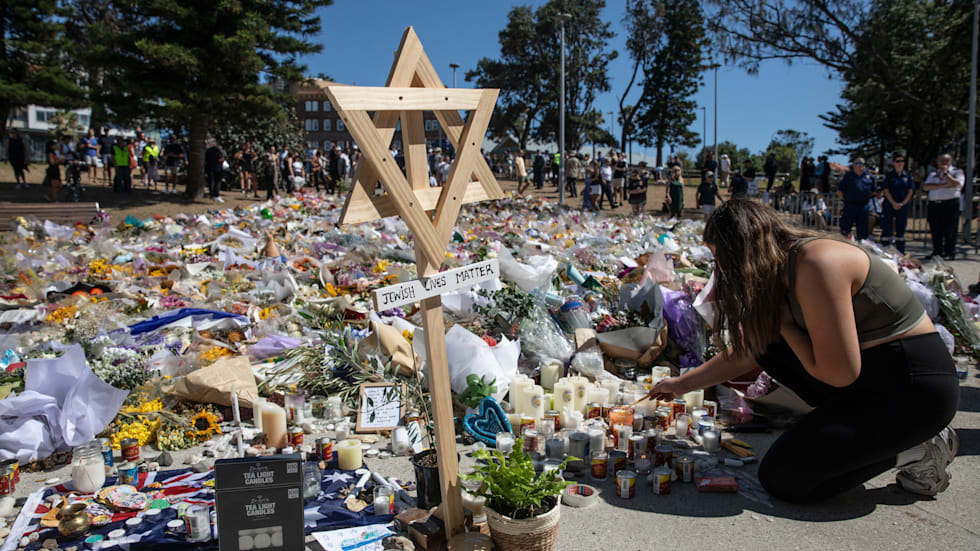
The terrorist attack on Bondi Beach arouses many strong emotions. Photo: Per Elinder Liljas
Anger is simmering after the terrorist attack on Bondi Beach. Many Australians believe the government should have done more to stop anti-Semitism. “We thought we were safe here,” says Colby Wigoder.
Per Elinder Liljas
Published20:03
Follow writer
SYDNEY A woman ties balloon animals. There is face painting and you can drive radio-controlled excavators. In one corner of the venue, bread, potato pancakes and doughnuts are served. On stage, at a nine-branched candlestick that is bigger than he is, a rabbi talks about the Maccabees. About peace and unity. And how everyone has something good inside.
Then it pops. People startle. A balloon animal has broken.
“That's exactly what the first shots sounded like on Sunday,” says the rabbi.
He says it perhaps to take the tension out of the room. But not to explain. Everyone makes the connection anyway.
It's been four days since the attack. Since fifteen people lost their lives because they were Jews or happened to be near them. Four days since life was last normal.
For security reasons, Thursday's Hanukkah celebration has been moved from the pedestrian street Martin Place to a basement room in City Hall.
Like most of the other participants, Colby Wigoder looks reasonably composed. But his eyes wander and his lips tremble. Beneath the surface, things are boiling.
The worst attack in the country ever
– How do you think it feels? We also want to celebrate our holidays openly. Instead, we are confined to a basement, like a bunker.
He also suspects that the fact that they are in this location, surrounded by police and security guards, has to do with the mayor being there.
– I'm pissed. We thought we were safe here. That these kinds of attacks only happen in Europe. At the same time, everyone has felt the threat growing. But the mayor has done nothing to protect us.
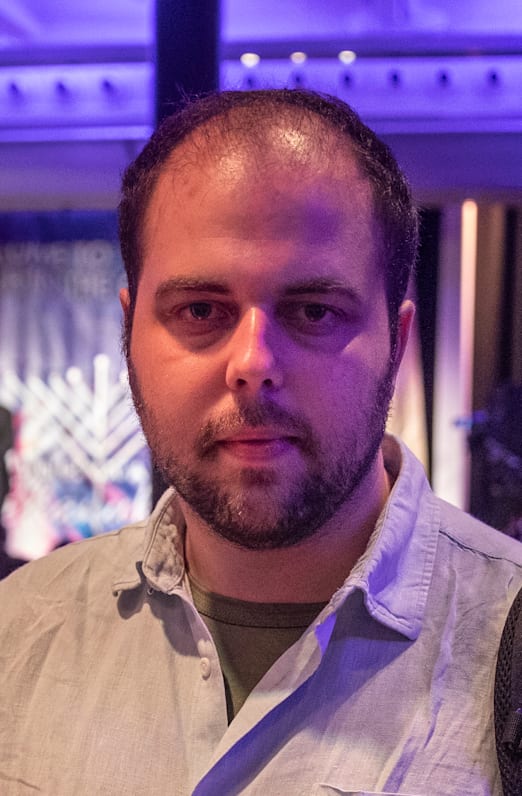
Colby Wigoder at the Hanukkah celebration at the city hall. He believes the government should have done more to protect Jews. Photo: Per Elinder Liljas
Wigoder, a Jew born in Australia to parents from Zimbabwe and South Africa, says that in recent days he has been thinking about moving to Israel.
– How crazy is that? I'm considering leaving the beach life for a place where Iran can reach us with its missiles.
Sunday's attack is not only a trauma for Australia's hundreds of thousands of Jews, but also for the country at large. It is the worst terrorist attack on Australian soil ever. And the first mass shooting since 1996. Then tough gun laws were introduced, which many thought would mean the danger was over.
That didn't happen.
Record levels of anti-Semitism
On Thursday, three of the victims were buried. One of them had survived the Holocaust. Another had not even turned eleven. Her Ukrainian parents named her the most Australian of names – Matilda.
Now they have asked the nation to remember her by her nickname: "The Bee."
Since then, memorial sites have begun to overflow with stuffed bees and drawings of bees. A smiling bee holding a nine-armed candlestick has been designed. People wear that image on stickers and lapel pins.
In the city hall basement, a girl gets it painted on her arm. She is ten years old herself. A few hours earlier, she had attended the funeral.
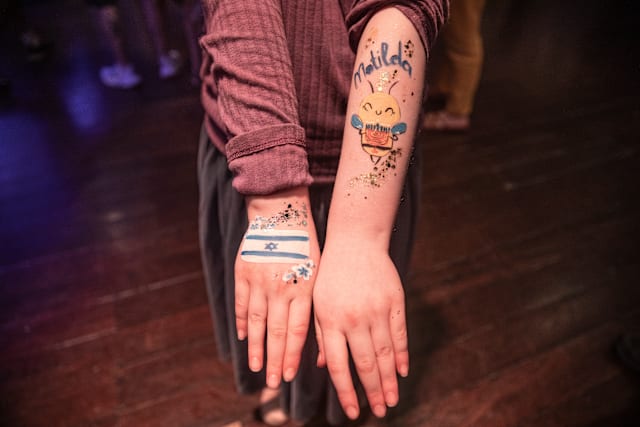
A ten-year-old shows his paintings, which pay tribute to the dead ten-year-old victim Matilda, also known as "the bee". Photo: Per Elinder Liljas
“I don't know if it was such a good idea,” says her father Michael.
– She was very worried afterwards. But her mother thought she could come along.
How do you explain what happened to her?
– We say it was evil. Pure evil.
Several politicians attended Matilda's packed funeral. But not Prime Minister Anthony Albanese. It has raised questions about whether he is afraid of being criticized. Many accuse the current government of not doing enough to protect the country's Jews. Anti-Semitism has recently reached record levels. And the number of physical attacks on Jews has increased.
The “nightmare scenario” not unexpected
In the past year alone, two synagogues, a kindergarten, and a kosher deli have been set on fire, with at least one case traced to the Iranian government.
Since the Hamas massacre on October 7, 2023, tensions have increased.
– Now swastikas are scrawled on Stars of David and Israeli flags are burned, says Colby Wigoder.
In February, Australia's intelligence agency identified anti-Semitism as the country's biggest deadly threat, citing attacks by lone perpetrators as the most likely culprit. This is true for Sajid Akram and his son Naveed, who are suspected of Sunday's attack.
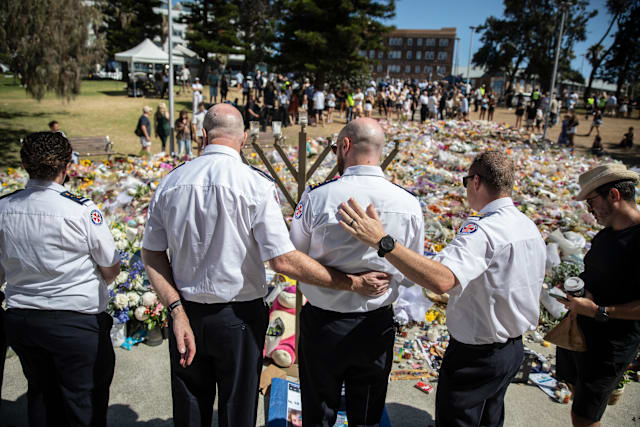
Ambulance paramedics honor the victims. Photo: Per Elinder Liljas
In other words, the attack does not come as a surprise, says Greg Barton, a terror expert and researcher in global Islamic politics at Deakin University.
– It was the nightmare scenario we were afraid would happen.
Still, he believes that all criticism of the government is not justified. And he regrets that the opposition has started to politicize the issue. The problem goes back further than this government took office.
“The perpetrators were also lucky,” he says.
Received firefighting training
For example, Naveed slipped through the security net in 2019, when an Islamist terrorist cell was blown up in Sydney. In connection with that, an eighteen-year-old Naveed was questioned and does not appear to have been under surveillance since. One reason for this, Barton believes, is that the main threat at the time was considered to come from right-wing extremism.
– Just a few months later, the Christchurch massacre occurred. It proved to the authorities that the concerns were correct.
In recent months, or even years, Sajid Akram and his son Naveed managed to keep their plans quiet. The act suggests long-term preparations, says Barton, without any connection to any network. Such communication would have been picked up by the security services, he says.
They also managed to go on a secret trip to the Philippines, where Barton believes they likely had contact with Islamist terrorists to receive training in gunfire.
– People don't visit this part of the southern Philippines for vacation. But if they had traveled to the Middle East instead, it is very possible that it would have set off alarm bells.
“Something has changed forever”
The sun warms Bondi Beach. A surfer breaks free from the other bobbing shapes in the water and rides a sizzling wave towards land. The beach is almost empty. A white sheet hangs by a walkway. In front are flowers and markers. Jesse Clark writes: “Bondi remembers you forever.”
– I had just come home when I heard the shots. It was a lovely summer day, just like today. But full of people. At first I ran out onto the balcony, but my friend pulled me back inside.
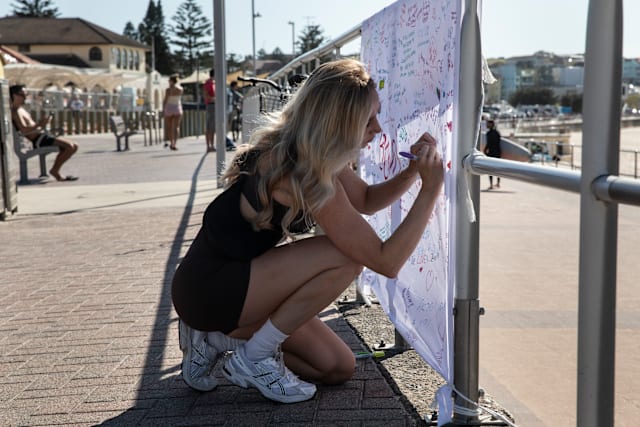
Jesse Clark writes a message for the victims of the Bondi Beach terror attack. Photo: Per Elinder Liljas
She bursts into tears. This is the first time she's been back on the beach since then.
– I haven't been able to get down. It's just so heavy. We're all in shock. Bondi is such a close-knit community, everyone knows and takes care of everyone. Now we're locking the door behind us. It's like after September 11, 2001, something has changed forever.
On a green field a short distance away lies the large memorial site. A sea of flowers. Noah Koncepolski stands handing out Jewish donuts.
– I hate the terms anti-Semitism and Islamophobia. In my world they don't exist. There is only anti-social behavior.
Extremism from many directions
Like many others, he wears a kippah.
– Some have become more nervous about showing that they are Jewish. For me, it's the opposite.
Suddenly a crowd dressed in blue arrives. About a hundred uniformed ambulance paramedics, the ones who were first on the scene. They lay down flowers, hold each other. Rabbi Levi Wolff stands in their midst and gives some words of encouragement. Help to get through the memories. Tears flow.
“You are our great angels,” he says.
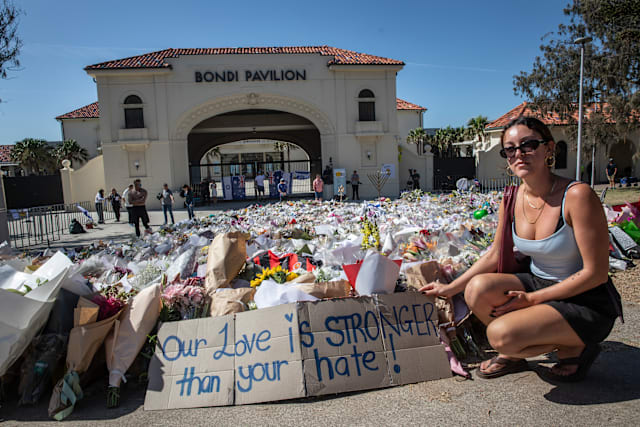
Bondibon Chloe places a homemade sign at the memorial site on Bondi Beach. Photo: Per Elinder Liljas
Chloe has been a Bondibo since birth. She has just placed a sign in front of the sea of flowers. “Our love is stronger than your hate,” it says. She can’t hold back her anger.
– People have brought their wars to our multicultural country. And all the woke people are playing into their hands. When Albanese recognized Palestine, he signaled that it is okay to hate Jews.
It has only gotten worse with the far-right's big marches, she says. The hate seeps in from all sides. Chloe mourns the effect it is having on her home.
– Bondi is a peaceful, laid-back community. We have taken pride in our blissful ignorance of the world's problems. We want nothing to do with this hatred.
Discussions about heroism
In a less affluent part of Sydney, bouquets are also being placed on the street. They are outside the shop of Ahmed al Ahmed, the Syrian man who disarmed one of the perpetrators. Chloe agrees that he is a hero.
– He shows that extremism has no place in any society.
Someone else mentions his name at the memorial site. Points out that there were also Jews who opposed the perpetrators. Reuven Morrison, who threw a brick and other objects at them. Boris and Sofia Gurman, who tried to disarm Sajid Akram as soon as he got out of the car. All three were shot dead.
A discussion starts.
Is there a reason why these Jewish heroes aren't celebrated in the same way? Is it because the films about them came out later, and they didn't survive? Or is it just because they are Jewish?
The grieving process is ongoing. But it also brings wounds to the surface. Michael, whose daughter had Matilda's name painted on her arm, says that in recent days he has been walking around town with a kippa for the first time in a long time. Before, people looked at him strangely. But not now.
– Now people stop me and offer their sympathy.